City Council vs Select Board
The names can sound interchangeable, but they are not. In Massachusetts, a city council is generally a city’s legislative body, while a select board generally leads a town’s executive administration, with town meetings serving as the town’s legislative body. Understanding that distinction helps residents follow decisions, helps reporters find the right meeting, and helps municipal staff maintain a clear public record.
What Is the Difference Between a City Council and a Select Board?
A city council is typically the legislative body of a city. It debates and adopts ordinances, acts on appropriations, and represents residents in the city’s lawmaking process.
A select board is usually the chief executive and policymaking body of a town. It sets broad administrative direction, coordinates town operations, and carries out duties assigned by state law, local bylaws, and the town charter.
The simplest way to remember the difference is this: a city council primarily legislates in a city. A select board primarily governs and administers in a town. In a town with town meetings, the voters or elected town meeting members usually serve as the legislative body.
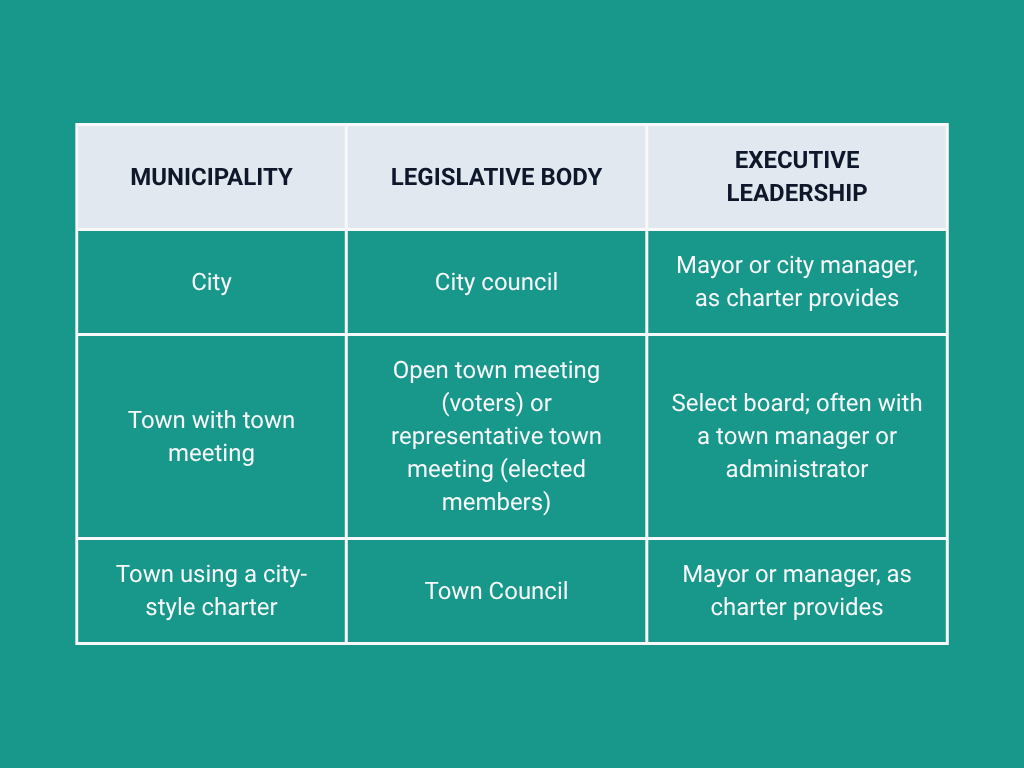
That does not mean every Massachusetts town has a city council, though. The usual town model pairs a legislative town meeting—open to voters or made up of elected representatives—with an executive select board. Cities generally have a city council as their legislative body, with a mayor leading administration. Some municipalities that still call themselves towns instead use a town council under a city-style charter. The name on the map is therefore less useful than the local charter when you need to know who legislates and who leads the executive branch.
A quick guide to the common arrangements:
The 14 Massachusetts municipalities that call themselves towns but use a city form of government are: Agawam, Amherst, Barnstable, Braintree, Bridgewater, East Longmeadow, Franklin, North Attleborough, Palmer, Randolph, Southbridge, West Springfield, Weymouth, and Winthrop. Their legislative bodies are town councils, even though their names say “town.”
These are common arrangements, not a rule that settles every possible combination of offices. If a municipality appears to have both a council and a select board, its current charter or special act is the place to check how those bodies coexist and what each can do.
What a City Council Does
A city council sits on the legislative side of city government. Its exact authority depends on the city charter, but common responsibilities include:
Adopting ordinances and resolutions
Reviewing and acting on the mayor’s or manager’s proposed budget
Approving, reducing, or rejecting appropriations within the limits of state law and the charter
Representing the city at large, individual wards, or a combination of both
Conducting public hearings and exercising oversight or confirmation powers assigned by the charter
The executive side of a city government is usually led by a mayor. That creates a familiar division: the executive proposes or administers, while the council debates, authorizes, and oversees.
What a Select Board Does
A select board sits on the executive side of town government. Massachusetts guidance describes it as a town’s chief policymaking body and, in many communities, its chief executive body. Common responsibilities include:
Setting town-wide goals and administrative policy
Coordinating the general operations of town government
Appointing certain officials and employees
Serving as a licensing authority
Preparing or issuing the town meeting warrant
Participating in budget development and managing approved funds
Overseeing a town administrator or town manager where the local structure provides for one
A select board does not usually replace town meetings. Town meetings remain the legislative body, voting on bylaws, major appropriations, and other warrant articles. The select board helps lead the town between those legislative decisions and puts adopted policy into practice.
Why the Distinction can Still Get Confusing
Massachusetts municipalities have substantial flexibility to organize themselves through local charters and special acts. A charter can distribute duties among a mayor, council, manager, administrator, select board, and other local offices.
That means job titles alone do not tell the whole story. One city council may have powers that another does not. One select board may directly appoint department heads, while another delegates more authority to a town manager.
When the exact authority matters, start with the municipality’s charter, bylaws or ordinances, and the relevant Massachusetts General Laws. The local charter is the operating map.
What Both Bodies have in Common
City councils and select boards are different, but their meetings create many of the same public-record demands. Both handle consequential questions about budgets, personnel, land use, licensing, public safety, and community priorities. Both must conduct public business in a way residents can follow. Both rely on accurate agendas, minutes, and accessible records.
And both can generate hours of discussion that staff, officials, residents, and journalists may need to revisit months or years later.
The Meeting-Record Challenge is the Same
A title tells you where a body sits in government, but it does not make the meeting easier to document.
A city council clerk may need to verify the language of a motion or vote. A town clerk may need to draft select board minutes after a long meeting. A resident may remember that an issue was discussed but not know the date. A reporter may need the exact context around a decision.
MuniTrac, InstaTrac’s municipal meeting platform, turns recorded public meetings into searchable, speaker-attributed transcripts and AI-generated, editable minutes supported by human review. Staff and the public can search within one meeting or across an archive, then jump directly to the relevant moment in the video.
The result is practical transparency: less time replaying recordings, a clearer path to review-ready minutes, and public records that are easier to search and use.
Make Every Public Meeting Easier
Whether your community is documenting a city council, select board, school committee, or regulatory board, the public record should work for the people who maintain it and the people who rely on it.
Book a Demo to see how MuniTrac can reduce the administrative burden of meeting documentation while keeping municipal staff in control of the final record.